

Why x402?
There are fundamental issues with payments on the internet:- Traditional payments: high card fees (2–3%), minimum charge limits, high integration barrier, not suitable for programmatic calls
- Web3 payments: fragmented, non-unified interfaces, complex details like gas/RPC to handle, high development and UX costs
What is x402?
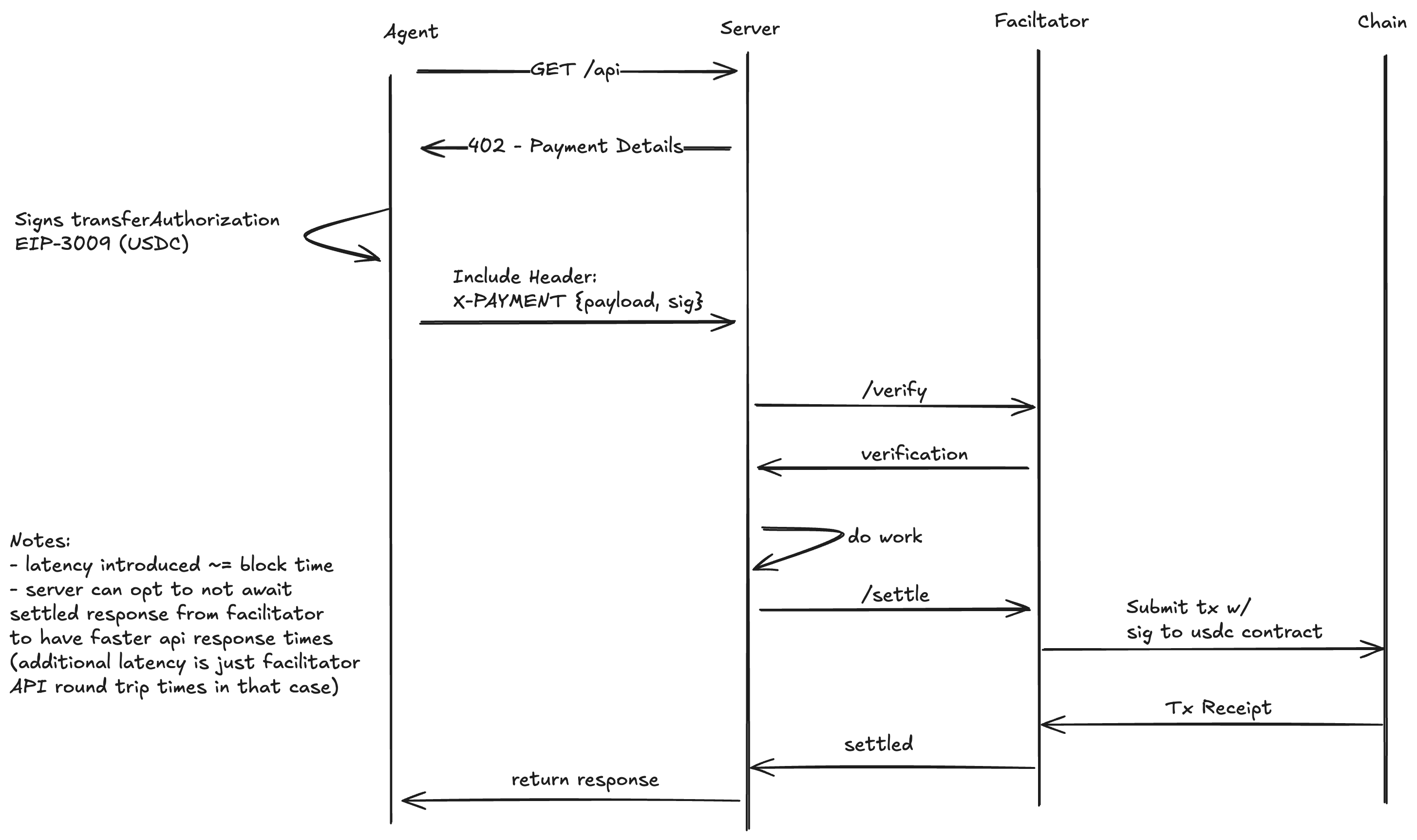
x402 is an open on-chain micropayment protocol based on the HTTP 402 status code. It standardizes the full flow of “request → pay → retry → get resource”:- Client sends an HTTP request
- Server returns
402 Payment Requiredwith payment requirements (PaymentRequirements) - Client generates a payment proof (signature or transaction) per the requirements and retries with the
X-PAYMENTheader - Server verifies and settles the payment
- Server returns
200 OKwith the resource, and includes on-chain transaction info in theX-PAYMENT-RESPONSEheader
Core principles
- Open standard: never requires dependency on a single party; anyone can implement it
- HTTP-native: seamlessly integrates into existing HTTP flows; no extra roundtrips
- Chain/Token agnostic: supports any chains and token standards via scheme extensions
- Minimal trust: all payment options must ensure funds only move per the buyer’s intent
- Easy to use: abstracts crypto complexity (gas, RPC, etc.); client/server in 1–2 lines of code
Core concepts
- Resource: any content on the internet — webpages, files, APIs, RPC services, etc.
- Client: the entity who wants to pay for a resource (users, AI agents, etc.)
- Resource Server: an HTTP server that provides resources (merchant)
- Facilitator Server: a third-party service that helps verify and execute on-chain payments (optional)
- Scheme: a logical way to transfer value (e.g.,
exactfor exact payments,uptofor usage-based)